
Search for “how to prepare for a deep cleaning” and you get the same three instructions every time: declutter, gather your supplies, work room by room. None of them mention what decides how the day goes, whether you do the cleaning yourself or pay someone else. Preparing for these two situations is almost opposite. Worse still, much of what people do the day before doesn’t change the outcome.
I’ve been to many homes where someone had clearly spent their evening vacuuming the floors and wiping down the benches before we arrived. That’s a nice thought. This also means they did the easy ten minutes of our work and skipped the part that would have actually helped, like clearing out the spare room so we could get to the windows. The preparation is worth it. It’s just worth doing the parts that matter.
Key takeaways
- The first question to answer is who does the cleaning. Everything else follows from that.
- Clearing access, benches, floors, items you would otherwise clean, does more for the bottom line than any pre-cleaning you could do.
- If you’ve booked a crew, don’t pre-vacuum or clean the things you’re paying them to do. Instead, give them access and a brief briefing.
- A supplies check, a pet plan, and an early start on laundry are the three things most people forget about until the morning.
- Proper preparation makes the difference between a deep cleaning that goes as planned and one in which half the time is spent moving items that should have already been moved.
Start with a question: who actually does the cleaning?
Before you touch anything, fix this. The answer reshapes the rest of the list.
If you’re doing it yourself, preparation involves putting in the hard work so you don’t lose momentum halfway through. That means laundry started early, beds taken down, supplies on hand, and a plan for the order in which you’ll work.
If you’ve booked a professional team, preparation is almost entirely about access and information. We bring our own equipment and products. What we can’t give you is a clear path to surfaces, or knowledge of the tasks that matter most to you. It’s your half of the job, and it’s the half that gets ignored.
Make this distinction correctly and you’ll avoid the most common mistake we see: People prepare for a deep cleaning as if they’re doing it, when they’ve rented it.

A preparation that changes the result
These are the jobs that are worth your evening. They are the same no matter who cleans, with a few extras reserved for DIY.
Clear benches, floors and surfaces.
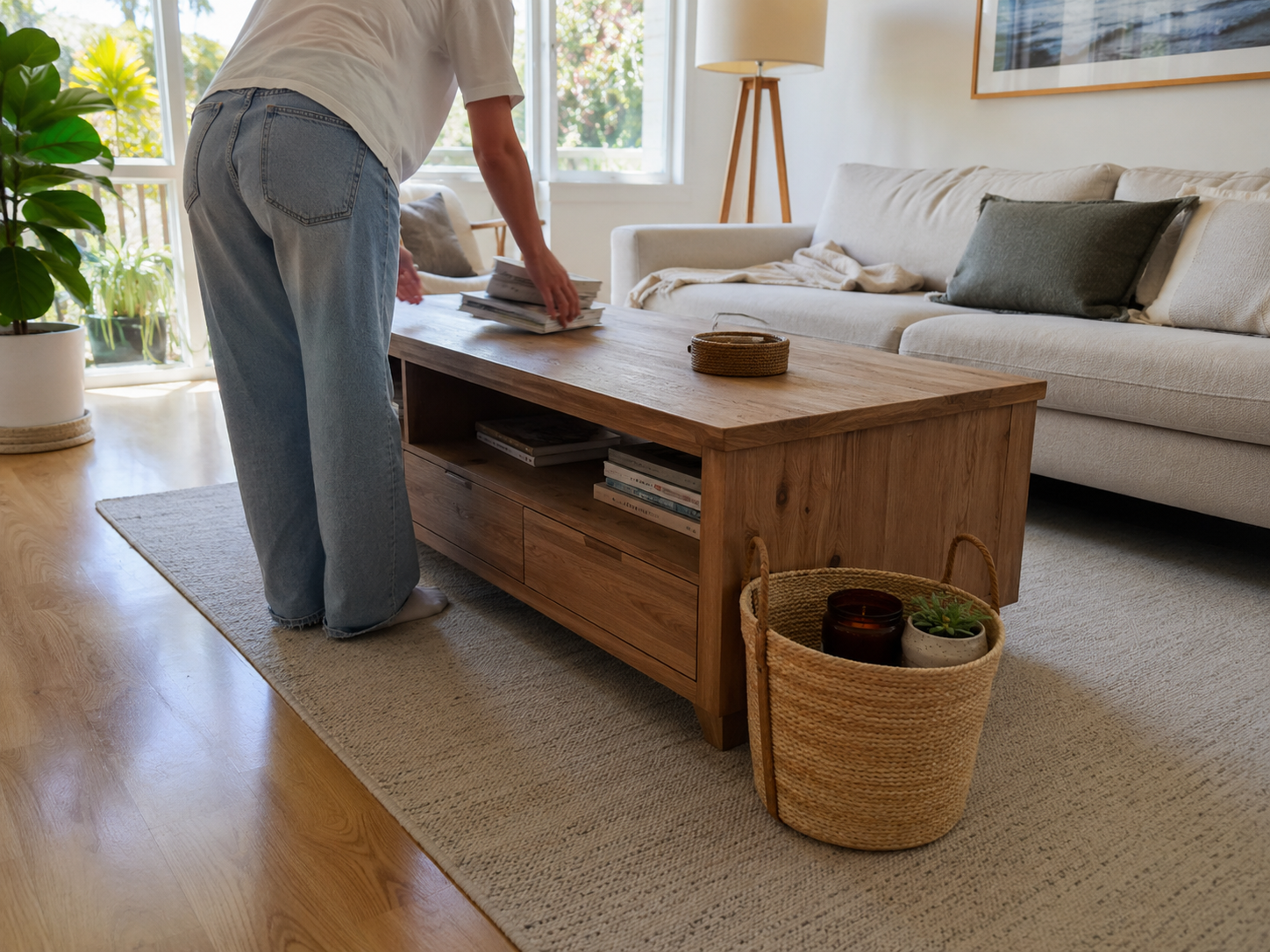
Anything placed on a bench, windowsill or on the floor must be picked up, cleaned or placed elsewhere before the surface underneath can be properly repaired. A clear surface is cleaned. A cluttered object is cleared around objects, which is not the same thing. This single step probably does more for the end result than anything else on the list.
Put away things you would otherwise clean.
Not a complete declutter, just the loose stuff: the laundry on the chair, the kids’ toys on the floor, the pile of mail. If you’ve been planning to do a good decluttering, that’s a separate project, and our decluttering guide is a better place to start than the day before a clean. For now, the goal is simply a room that someone can move around in.
Sort animals and access (everyone).
Decide where the dog or cat will be, especially if a team is arriving and the doors will be open. A stressed animal underfoot slows everything down and can escape through a wedged door. We’ve written separately about what to do with pets when the cleaner arrives, and it’s worth reading if this is your first booking. Also sort keys, gate codes and parking, so no one is on the doorstep at check-out time.
Start laundry and take down beds early (DIY).
If you’re cleaning yourself, do some laundry before you start and dismantle any beds you plan to redo. Laundry runs in the background while you work, providing dead time you’d otherwise waste at the end.
Do a quick supply check (DIY).
Go through what you’ll need before you start, not while you’re elbows in the oven. A basic kit covers most of a house: microfiber cloths, general spray, something for glass, cream cleaner for sinks and bathtubs, gloves and a good scrubbing brush for grouting. You don’t need a cabinet full of specialty products. Choice’s cleaning product reviews are a helpful reality check if you’re tempted by the marketing of a $15 spray that does the same job as a $4 spray.

Preparation that wastes your time
This is the part that other guides forget. Some of the most common pre-cleansing rituals accomplish nothing or make the day more difficult.
Pre-vacuuming and pre-wiping in front of a professional team.
If you paid for deep cleaning, vacuuming and wiping down surfaces is included. Doing them yourself first doesn’t give you a better result, it just means you’ve done some of the work you paid for. Instead, spend that energy on freeing up access.
Scrub what you pay us to clean.
The oven, the shower screen, the grout: these are exactly the jobs there are for deep cleaning, with the time and products to do them properly. Half-rubbing them the day before rarely helps and sometimes leaves a residue of half-dissolved product that we need to deal with first.
Too much storage in chaos.
There comes a time when “tidying up” means putting everything away in cupboards and spare rooms only to find nothing later. Clean surfaces, yes. Don’t create a different kind of mess behind a closed door that you’ll dig through for a week.
Buy specialized single-use products.
The bottle of stainless steel polish or stone-specific spray you buy for a single deep clean usually stays untouched in the cupboard afterward. Most surfaces match what you already have.

If you’ve hired a team, preparation is the most important thing
Two things, and they are worth more than anything you could do.
First of all, clear access to whatever you want to clean. If the team cannot reach the plinths behind the stock boxes, those plinths will not be completed. We can only clean what we can reach.
Second, leave a brief. A quick word or note at the beginning, telling us what matters most to you. Maybe it’s the oven, maybe the grout in the bathroom, maybe the windows because people are coming. We will do a thorough job in both cases, but knowing your priorities means time will be spent on what you really care about. If you’re not sure what to put away in advance, we’ve answered it right in the Should I Tidy Up Before the Cleaner Arrives section.
A note on timing
Two points specific to Australia merit consideration. In summer, open windows and dry northerly winds mean more dust and pollen settle on surfaces. A deep clean is therefore best done once the worst of the hot and windy period has passed rather than in the middle of it. And if the cleaning is related to an event, vacation guests, an inspection, a move, book it a few days in advance rather than the day before. It’s under the pressure of the day itself that things go wrong.
After cleaning: keep it that way
A deep cleaning resets the house. What happens next depends on your routine. A light weekly pass on high traffic areas, the kitchen, the bathroom, the floors, allows you to obtain the result for months rather than weeks. Our guide to maintaining your home between professional cleanings covers the little habits that do the heavy lifting.
The short version
Decide who does the cleaning. Clear surfaces and floors. Sort animals, keys and access. If you’re doing it yourself, start laundry early and check your kit. If you’ve hired a crew, don’t pre-clean, just clear the way and tell us what matters. Avoid rituals that seem productive but don’t change anything, and you’ll get a truly profound result without wasting an evening.
FAQs
Do I need to clean before the cleaners arrive?
Tidy, don’t clean. Clear surfaces and floors so the team can reach everything, put away clutter and sort animals. Leave the actual cleaning to them, including vacuuming and scrubbing. This is what you pay for.
How long does the preparation take?
For a hired cleaner, cleaning access and sorting pets and keys typically takes less than an hour for an average home. For a DIY deep clean, budget a little extra, mainly to do laundry and gather supplies before you start, so you don’t stop mid-job.
Do I have to be home during a deep cleaning?
Not necessarily. Many guests leave a key or arrange access and go about their business. If you prefer to go out, just leave your priorities in a note beforehand. If you’re staying, keeping pets and children in an area that’s already cleaned helps the team work on the rest.
What should I do if I can’t move heavy furniture myself?
Leave it. A professional team will move what is reasonable and safe as part of the cleanup. When DIYing, don’t risk your back on a cabinet or refrigerator. Clean what you can reach and accept that the spot behind the heavy piece can wait until next time.
Is deep cleaning the same as spring cleaning?
They overlap but are not identical. A deep clean is an intensive, thorough cleaning that you can do once or twice a year or before an event. Spring cleaning is typically seasonal and often includes decluttering and tasks like washing curtains or windows. If you’re looking for a seasonal reset, our spring cleaning page explains what that covers.
PakarPBN
A Private Blog Network (PBN) is a collection of websites that are controlled by a single individual or organization and used primarily to build backlinks to a “money site” in order to influence its ranking in search engines such as Google. The core idea behind a PBN is based on the importance of backlinks in Google’s ranking algorithm. Since Google views backlinks as signals of authority and trust, some website owners attempt to artificially create these signals through a controlled network of sites.
In a typical PBN setup, the owner acquires expired or aged domains that already have existing authority, backlinks, and history. These domains are rebuilt with new content and hosted separately, often using different IP addresses, hosting providers, themes, and ownership details to make them appear unrelated. Within the content published on these sites, links are strategically placed that point to the main website the owner wants to rank higher. By doing this, the owner attempts to pass link equity (also known as “link juice”) from the PBN sites to the target website.
The purpose of a PBN is to give the impression that the target website is naturally earning links from multiple independent sources. If done effectively, this can temporarily improve keyword rankings, increase organic visibility, and drive more traffic from search results.