
@font-face { font-family: ‘Heading2Font’; src: url(‘ format(‘opentype’); }
@font-face { font-family: ‘NOTOSANSREGULAR’; src: url(‘ format(‘truetype’); }
body { font-size: 15px !important; font family: ‘NOTOSANSREGULAR’; line-height: 1.7; }
h2 { font-family: ‘Heading2Font’; font size: 23px; line-height: 32px; bottom margin: 12 px; }
h3 { font-family: ‘Heading2Font’; font size: 20px; line-height: 28px; bottom margin: 10 px; }
ol > li { position: relative; padding left: 25 px; bottom margin: 10 px; counterincrement: item; }
ol > li::before { content: counter(item) “.”; position: absolute; left: 0; }
.toc-container { border: 1px solid #e5e5e5; padding: 20px; border-radius: 12px; background: #fafafa; margin: 20px 0; }
Mumbai doesn’t give you space and there’s not much you can do about it. You cannot change the layout or size of your house in Mumbai, but what you can do is design keeping in mind the constraints.
For most 1BHK and 2BHK owners in Andheri, Mulund, Chembur or Goregaon, the square footage is fixed. It’s never about getting more space. It’s about making the space you have work harder. This is what good small house interior design really solves.
What are the challenges of small house interior design in Mumbai?
Before moving on to solutions, it helps to name the specific problems. Apartments in Mumbai are subject to a particular set of constraints that differ from compact homes elsewhere.
Ceiling heights in buildings built after 2005 tend to be lower. Natural light is uneven and highly dependent on what floor you are on and the orientation of your windows. Ventilation is often limited to two or three openings, and cross ventilation is a luxury that most layouts cannot accommodate. Add to that the humidity that peaks between June and September, and some material choices simply cease to be viable.
Small house interior design ideas that work in an apartment in Delhi or an independent house in Bangalore don’t always translate here. The solutions must be calibrated for the specific building typologies of Mumbai.
What is the role of furniture in the interior decoration of small houses?
In a compact apartment, each piece of furniture takes up floor space that you cannot spare. The question to ask yourself before buying anything is: does it do one thing or many?
Furniture ideas that consistently earn their place in small home design include:
- Murphy beds and wall-mounted rollaway beds in studios and 1BHK apartments. When folded, they return the entire bedroom floor space to usable space during the day.
- Sleeper sofas in the living rooms which also serve as guest accommodation. Particularly relevant in 1BHKs in Powai or Vikhroli, where accommodating overnight guests in a separate bedroom is not an option
- Extendable dining tables that seat two people per day and extend up to six people when needed
- Poufs and storage benches at the entrance or at the foot of the bed. They absorb clutter while serving as seating
- Wall-mounted desks that fold flat when not in use. As remote working becomes a permanent reality for many Mumbai households, a dedicated work surface is important. This is one of the most practical small house interior design ideas for apartments, where a separate study is not feasible.
The principle followed by the best interior designers in Mumbai is consistent: if a piece of furniture does only one thing, it must do it exceptionally well to justify the floor space.
Why is vertical space the most underutilized asset in Mumbai homes?
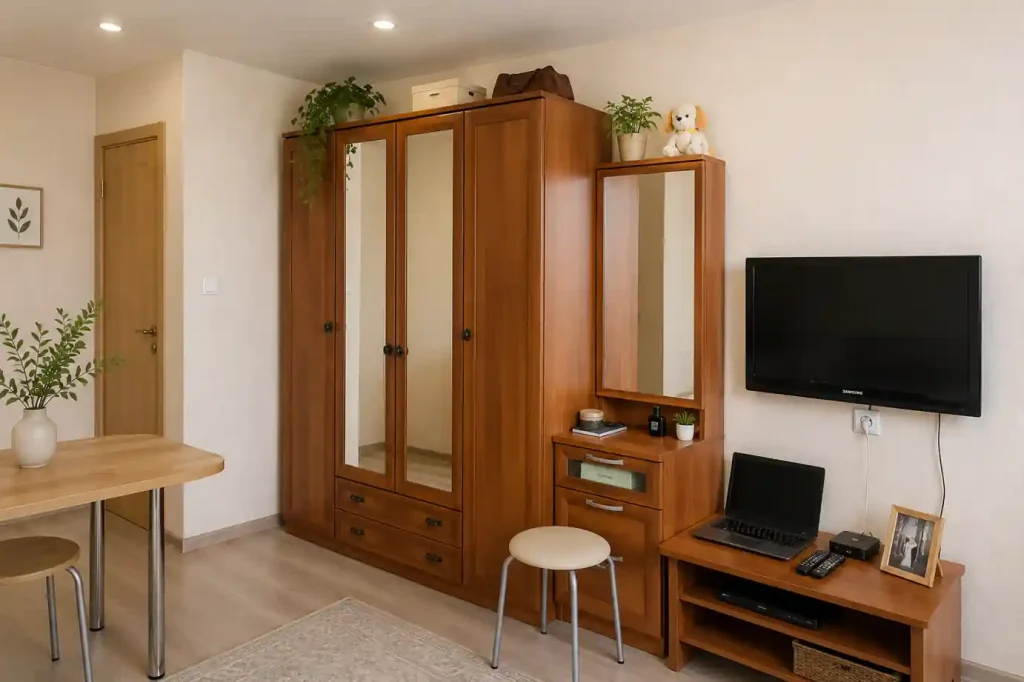
Most owners of compact apartments think horizontally. They plan the furniture along the walls, arrange the floor plan and call it a day. The space above eye level, from about 1.8 meters to the ceiling, is almost always unused.
A small house interior design that works well deliberately uses this area:
- Floor to ceiling shelves in the living room or bedroom. They create substantial storage space without increasing room clutter
- Wall cabinets in the kitchen above the counter, going all the way to the ceiling rather than stopping at the standard height. The upper shelves contain rarely used items; the visual effect is that of a fully designed wall rather than an afterthought
- Attic storage in rooms with adequate ceiling height, which is more common in older Bombay-era buildings in areas like Dadar or Matunga, where floor heights were more generous
- Hooks, pegboards and wall organizers in utility areas and bathrooms where floor space is particularly limited
Building vertically doesn’t make a room more cluttered. Made with consistent materials and finishes, this gives the room a more resolved look.
How to create zones without walls?
In a compact 1BHK or 2BHK, open layouts are often necessary rather than optional. The living room, dining room and kitchen occupy a single continuous space. The challenge is to make each area feel defined without physically dividing them.
The interior design of small apartments in Mumbai solves this problem through zoning rather than partitioning:
-
Rugs to anchor the living room and visually separate it from the dining area
Even a modest rug under the sofa and coffee table creates a distinct territory within an open floor plan.
-
Ceiling treatments or signal transition lighting modifications
A pendant light above the dining table, different from the ambient lighting in the living room, defines the dining area without any physical intervention.
-
Furniture arrangement as a limit
A sofa with its back to the dining room creates a separation. An open bookcase used as a low room divider between the living room and an office area achieves the same effect without blocking light or air.
-
Changes in materials on the floor
A kitchen finished with different tiling than the living room creates a natural boundary even in completely open plans.
These techniques give a compact apartment the feeling of a house with distinct rooms, without the surface cost of actual walls.
What materials are resistant to the Mumbai climate?
This is a practical consideration that small interior design projects often overlook. Mumbai’s humidity isn’t just uncomfortable for its residents. Over time, it actively damages certain materials.
What works:
-
Marine grade plywood for all joinery
Standard commercial ply warps and swells in high humidity, especially in kitchens and bathrooms.
-
Laminated parquet on solid wood
It better manages the movement of moisture and is more dimensionally stable throughout the seasons.
-
Powder-coated or stainless steel hardware on cabinets
Brass and iron hardware corrode more quickly in coastal areas, including most of south Mumbai and western suburbs close to the sea.
-
Moisture-resistant paint finishes in bathrooms and kitchens
Matte finishes are more difficult to maintain in humid conditions; a soft or satin finish is more practical.
For apartments in Bandra, Worli or Colaba, where sea air adds a corrosive element, the choice of materials deserves more attention than it usually receives.
How to plan the interior design of a small house to suit your lifestyle?
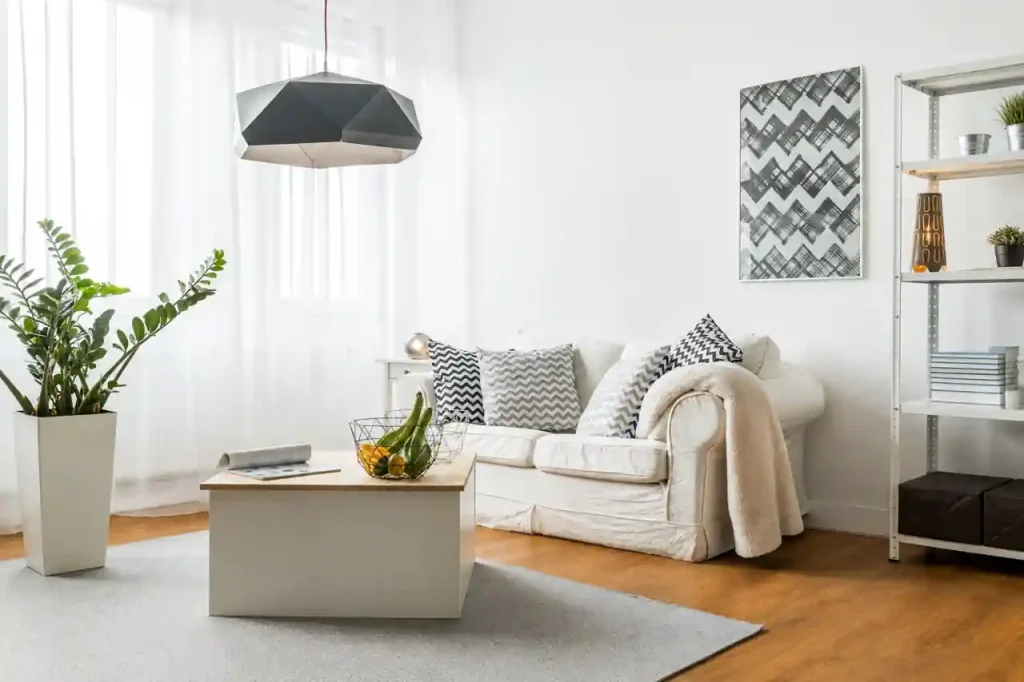
Small house interior design works best when built around specific routines rather than generic space-saving principles.
- A single professional in a 1BHK in Malad needs different things than a family of three in a 2BHK in Mulund.
- A couple who both work from home have different constraints than one where only one person does it
- A household that hosts frequently needs storage that quickly disappears when guests arrive.
Bonito Designs approaches the interior design of every small house in Mumbai with this specificity. With our Life Design philosophy, the design process begins with understanding how the household actually uses the space during a typical week, not just what the apartment looks like on a floor plan.
In-house execution and ISO certified processes ensure that storage solutions, material choices and layout decisions are delivered precisely, without the gaps that arise when the interior design and execution of a tiny home are handled separately.
A compact apartment and a well-designed house are not mutually exclusive. Small house interior design in Mumbai is a discipline that rewards specificity: knowing the building, knowing the layout, knowing the family, and making decisions that reflect all three.
If you’re ready to redesign your apartment in Mumbai and want it to work as hard as the city you live in, book a consultation with Bonito Designs today.
PakarPBN
A Private Blog Network (PBN) is a collection of websites that are controlled by a single individual or organization and used primarily to build backlinks to a “money site” in order to influence its ranking in search engines such as Google. The core idea behind a PBN is based on the importance of backlinks in Google’s ranking algorithm. Since Google views backlinks as signals of authority and trust, some website owners attempt to artificially create these signals through a controlled network of sites.
In a typical PBN setup, the owner acquires expired or aged domains that already have existing authority, backlinks, and history. These domains are rebuilt with new content and hosted separately, often using different IP addresses, hosting providers, themes, and ownership details to make them appear unrelated. Within the content published on these sites, links are strategically placed that point to the main website the owner wants to rank higher. By doing this, the owner attempts to pass link equity (also known as “link juice”) from the PBN sites to the target website.
The purpose of a PBN is to give the impression that the target website is naturally earning links from multiple independent sources. If done effectively, this can temporarily improve keyword rankings, increase organic visibility, and drive more traffic from search results.